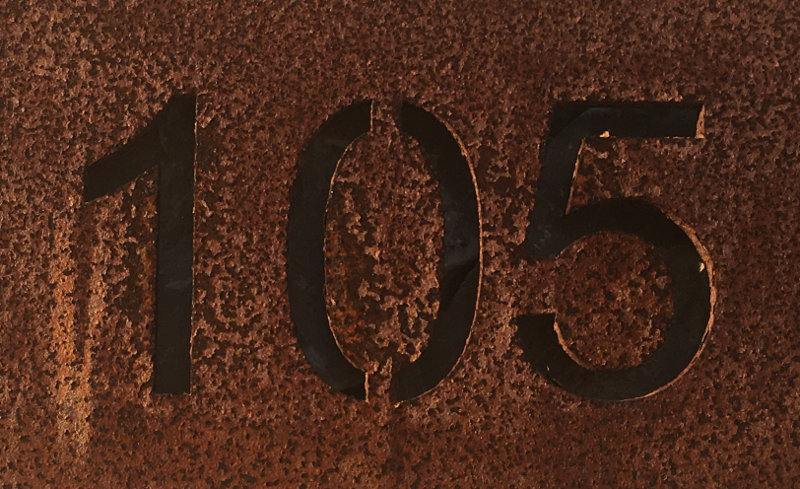
105 (one hundred [and] five) is the natural number following 104 and preceding 106.
In mathematics
105 is the 14th triangular number, a dodecagonal number, and the first Zeisel number. It is the first odd sphenic number and is the product of three consecutive prime numbers. 105 is the double factorial of 7. It is also the sum of the first five square pyramidal numbers.
105 comes in the middle of the prime quadruplet (101, 103, 107, 109). The only other such numbers less than a thousand are 9, 15, 195, and 825.
105 is also the middle of the only prime sextuplet (97, 101, 103, 107, 109, 113) between the ones occurring at 7-23 and at 16057–16073. 105 is the product of the first three odd primes () and is less than the square of the next prime (11) by > 8. Therefore, for , n ± 2, ± 4, and ± 8 must be prime (a prime k-tuple). In contrast, n ± 6, ± 10, ± 12, and ± 14 must be composite, making a prime gap on either side.
105 is also a pseudoprime to the prime bases 13, 29, 41, 43, 71, 83, and 97. The distinct prime factors of 105 add up to 15, and so do those of 104; hence, the two numbers form a Ruth-Aaron pair under the first definition.
105 is also a number n for which is prime, for . (This even works up to , ignoring the negative sign.)
105 is the smallest integer such that the factorization of over Q includes non-zero coefficients other than . In other words, the 105th cyclotomic polynomial, Φ105, is the first with coefficients other than .
105 is the number of parallelogram polyominoes with 7 cells.
References
- Wells, D. The Penguin Dictionary of Curious and Interesting Numbers London: Penguin Group. (1987): 134